

Deep TMS (dTMS) and repetitive TMS (rTMS) are both forms of transcranial magnetic stimulation, a non-invasive treatment that uses magnetic fields to stimulate areas of the brain. These therapies are primarily used to treat conditions like major depressive disorder and anxiety.
Although both techniques aim to promote the brain’s inherent neuroplasticity and enhance neural connections, they differ significantly in their mechanisms and applications. At Neuralia TMS, we focus on providing effective, drug-free treatment options that target various conditions, including depression, OCD, PTSD, and anxiety. Let’s review rTMS vs dTMS!
Key Takeaways
- Deep TMS penetrates deeper into the brain compared to standard rTMS.
- rTMS is effective for treating major depressive disorder and anxiety.
- Both treatments are non-invasive and have minimal recovery time.
- dTMS uses a unique H-coil design for broader brain stimulation.
- Safety profiles for both therapies are well-documented, with mild, rare side effects.
What is TMS?
Transcranial magnetic stimulation (TMS) is a groundbreaking treatment that employs high-strength magnetic fields to stimulate nerve cells in the brain. TMS targets the dorsolateral prefrontal cortex (DLPFC), an area often underactive in individuals suffering from major depressive disorder. By delivering repeated magnetic pulses to this region, TMS helps reset and increase the brain’s firing patterns. The stimulation can lead to increased activity in the DLPFC, which is associated with improved emotional regulation and reduced symptoms of depression.
TMS is particularly beneficial for individuals suffering from major depressive disorder (MDD), as it can help alleviate symptoms without the need for medication or invasive procedures. TMS therapy is quick and can be integrated into daily routines without requiring recovery time or hospital admissions.
Types of TMS: rTMS vs dTMS
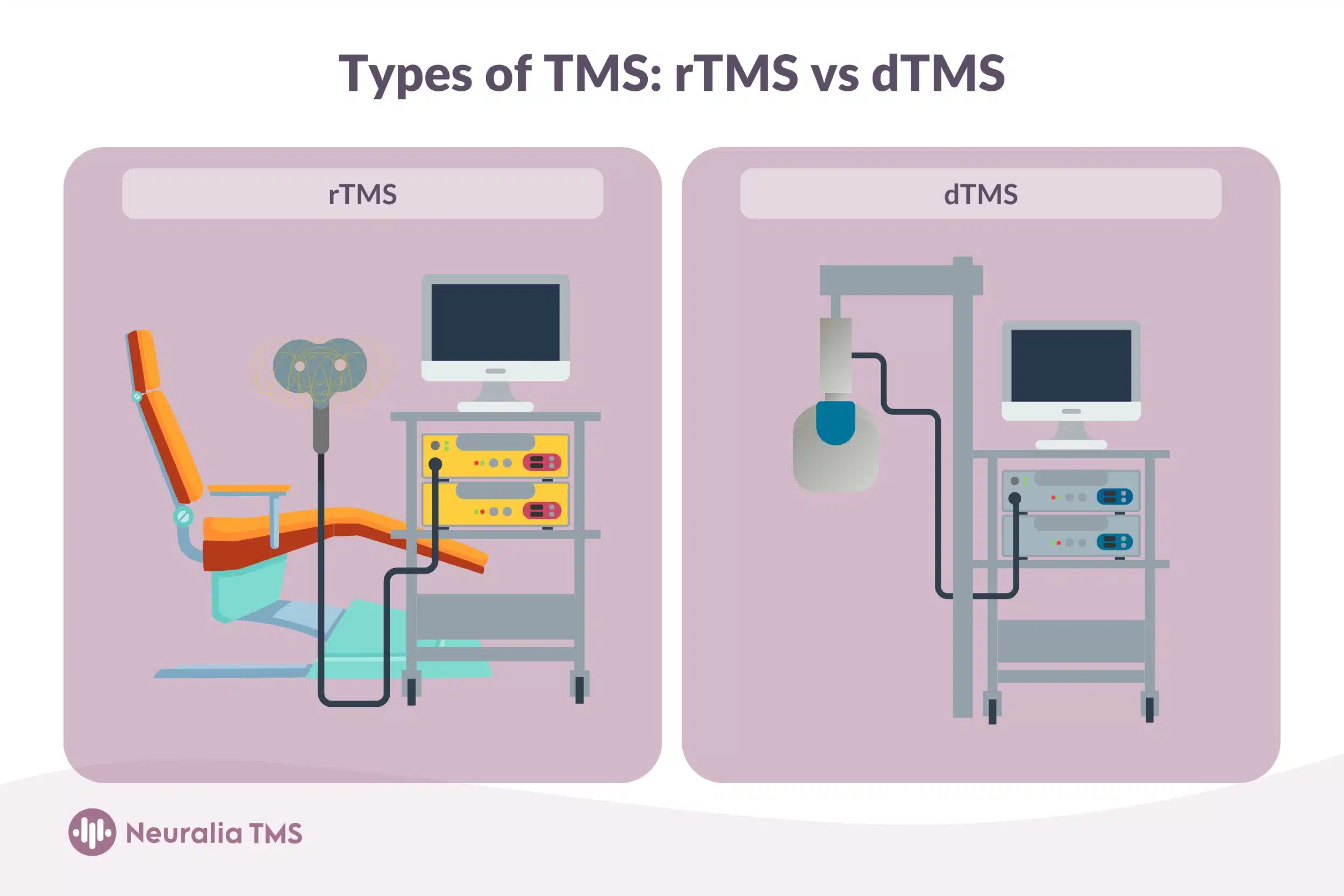
There are two primary types of TMS used for treating MDD and anxiety: rTMS and dTMS.
| Feature | Repetitive Transcranial Magnetic Stimulation | Deep Transcranial Magnetic Stimulation |
|---|---|---|
| Coil Design | Figure-8 | H-coil |
| Depth of Penetration | 0.7 cm | Up to 3.2 cm |
| Treatment Duration | 20 to 40 minutes per session | 20 to 30 minutes per session |
| Common Side Effects | Headaches, scalp discomfort, lightheadedness | Headaches, scalp discomfort, lightheadedness |
dTMS
- Definition: An advanced form of TMS that uses an H-coil design to deliver deeper stimulation.
- Mechanism: This technique allows stimulation of deeper brain structures, such as the anterior cingulate cortex, which can be beneficial for treatment-resistant depression.
- Applications: dTMS is effective for major depressive disorder and other conditions like Obsessive-Compulsive Disorder (OCD).
rTMS
- Definition: A standard form of TMS that uses repeated magnetic pulses to stimulate specific brain regions.
- Mechanism: rTMS typically employs a figure-8 coil to deliver stimulation directly over the prefrontal cortex, an area associated with mood regulation.
- Applications: rTMS is especially used for treating depression, anxiety, chronic pain (including migraines), tinnitus, post-traumatic stress disorder (PTSD), and other mental health disorders.
Technical Differences Between dTMS and rTMS

The technical differences between deep TMS and rTMS include the coil designs and stimulation depth. These differences are significant in terms of their effectiveness and applications.
Coil Design
- rTMS Coil: The figure-8 coil is designed to focus stimulation on specific areas of the brain. This allows for precise targeting but limits the depth of penetration.
- dTMS Coil: The H-coil enables broader stimulation across multiple brain regions, enabling deeper penetration into brain structures.
Stimulation Depth
- rTMS is effective primarily in stimulating superficial brain areas, which may not be sufficient for all patients.
- dTMS is capable of reaching deeper structures within the brain, potentially leading to more comprehensive treatment outcomes.
Efficacy
Research indicates that both forms of TMS have similar efficacy rates in treating major depressive disorder. However, dTMS may offer advantages for patients with treatment-resistant depression because it stimulates deeper brain regions.
How Can TMS Help You Overcome Depression and Anxiety?
TMS can significantly alleviate symptoms of depression and anxiety by targeting specific areas of the brain responsible for mood regulation (primarily the DLPFC). This non-invasive therapy works by using magnetic fields to stimulate nerve cells, enhancing neuroplasticity and promoting increased and healthier brain activity.
Efficacy in Treatment-Resistant Cases
One of the main advantages of TMS is its effectiveness in treating treatment-resistant depression. Many patients experience huge improvement after undergoing TMS therapy, even when previous treatments like medication and psychotherapy have failed. This makes TMS a valuable option if you have not found relief through standard treatments.
Reduced Side Effects
Compared to traditional antidepressant medications, TMS has a much lower risk of side effects. Common side effects associated with antidepressants include nausea, weight gain or loss, and sexual dysfunction. In contrast, TMS may cause mild discomfort or headaches during sessions, but these effects are typically short-lived. Importantly, TMS does not require anaesthesia or sedation, so you can resume your daily activities immediately after treatment.
Address Anxiety Symptoms
While TMS is primarily known for its efficacy in treating depression, it can also help alleviate anxiety symptoms. The therapy can reduce hyperactivity in the prefrontal cortex, which is often linked to anxiety disorders. Patients experiencing both anxiety and depression may find that their anxiety symptoms improve alongside their mood as a result of TMS treatment.
Support Neuroplasticity
TMS stimulates neuroplasticity – the brain’s ability to form new connections – which is crucial for recovering from depression and anxiety. By promoting the growth of new neural pathways, TMS helps patients break free from negative thought patterns and behaviours that contribute to their conditions.
Neuralia TMS: Start Your Drug-Free Treatment Today
At Neuralia TMS, we provide advanced TMS therapy tailored to individual needs. Our focus is on treating conditions like depression and anxiety effectively without relying on medication. With our state-of-the-art technology and experienced staff, we ensure a safe environment for your treatment.
Contact us today to learn more about how our TMS therapies can help you reclaim your life.
Deep TMS vs rTMS FAQs
What are the three types of TMS?
The three types of TMS include rTMS, dTMS, and theta burst stimulation (TBS). rTMS uses rhythmic magnetic pulses to recalibrate neural pathways, whereas dTMS uses specialised coils to penetrate deeper brain regions. Moreover, TBS delivers rapid bursts of magnetic energy at specific frequencies, which can achieve remarkable results in shorter sessions.
What are the advantages of TMS over deep brain stimulation?
TMS is a non-invasive brain stimulation method, unlike deep brain stimulation (DBS) which requires surgery and implants. TMS is a much safer alternative with fewer risks, as demonstrated in multiple randomised controlled trials evaluating the safety of various deep brain therapies. TMS offers an effective depression treatment without the significant recovery time or potential complications associated with surgical stimulation techniques like deep brain stimulation.
How much does TMS cost in Australia?
At Neuralia TMS, patients under Medicare can receive transcranial magnetic stimulation therapy for major depressive disorder with no out-of-pocket fees, making the effective cost $0. Other clinics charge upfront costs between $100 and $250 per session, with out-of-pocket costs ranging from $40 to $100 per session after Medicare rebates. Despite these costs, the affordability underscores the value of nerve stimulation therapy, highlighting the efficacy and safety of rTMS and dTMS as practical and accessible treatment options for depression.
What are the advantages of TMS over ECT?
TMS is a non-invasive, outpatient procedure that, unlike electroconvulsive therapy (ECT), does not require anaesthesia or induce seizures. TMS is known for its minimal side effects – mild scalp discomfort or headache – compared to ECT’s risks of memory loss and confusion. Additionally, TMS allows patients to resume their daily activities immediately after treatment, offering a safe, effective, and less intimidating option for those seeking relief from depression.
Back to Top: Deep TMS vs rTMS


