

Complex PTSD (C-PTSD) vs. PTSD: Recognising and Treating Complex Trauma
https://www.neuraliatms.com.au/wp-content/uploads/Where-TMS-Fits-as-a-Treatment-Option-Complex-PTSD-Treatment.png
1500
1000
Neuralia TMS
//www.neuraliatms.com.au/wp-content/uploads/2023/02/neuralia-tms-colour-wide.svg
Is OCD Neurodivergent?
The question, “Is OCD neurodivergent?” has a lot of different answers based on who you ask. Although some people can confidently affirm that OCD is a form of neurodivergence, our team at Neuralia TMS believe that it’s up to individuals with Obsessive-Compulsive Disorder (OCD) to decide. As OCD symptoms vary in intensity, some people with OCD may feel more comfortable calling themselves neurotypical if their condition doesn’t significantly impact their lives.

If you want a better understanding of whether OCD is considered neurodivergent, you’ve come to the right place. We’ve outlined what neurodivergence and OCD are, how they’re connected, and how to help people with symptoms of OCD.
Key Takeaways
- There is no universal consensus on whether OCD is neurodivergent. Perspectives vary based on individual experiences and their overlap with conditions like autism spectrum disorder (ASD) and ADHD.
- OCD exhibits distinct neurological differences, atypical cognitive processing, and shared traits with neurodivergent conditions, but it is traditionally classified as an anxiety disorder.
- Identifying OCD as neurodivergent can be a personal choice, influenced by its impact on your daily life, relationships, and self-perception.
Does OCD Count as Neurodivergent?
There is no universal consensus on whether OCD should be categorised as a neurodivergent condition. Today, there are over 500,000 Australians with Obsessive-Compulsive Disorder and symptoms that impact their life to varying degrees.
Some people with OCD may consider themselves part of the neurodivergent group, while others may feel as though the term doesn’t match their lived experiences. To understand the link between OCD and neurodivergence, it’s important to discuss each separately.
What is Neurodivergence?
Neurodivergence is the term used to describe when the human brain functions differently compared to how it typically would. According to Northwestern Medicine, around 15 to 20% of the world’s population shows signs of neurodivergence, which includes a wide spectrum of conditions like autism spectrum disorder (ASD), ADHD, PTSD, as well as several other anxiety and mood disorders.
Neurodiversity is an umbrella term that covers these differences, which includes neurotypical and neurodivergent individuals.
What is OCD?
The clinical definition of Obsessive-Compulsive Disorder is that it is a mental health condition that involves uncontrollable and persistent thoughts and behaviours. These often intrusive thoughts, feelings, or urges are the obsessions that the individual with OCD is compelled to act on to ease the tension caused by the obsession (these acts are known as compulsions).
OCD can develop at any time in your life, but it often starts in late childhood or early adolescence. Moreover, some adults develop OCD in their early 20s, however, it is possible to develop OCD later in life as well.
People diagnosed with OCD may obsessively worry about any everyday activity, which intrudes on their quality of life while at work or home. Thankfully, OCD is a treatable mental health condition. Neuralia TMS provides transcranial magnetic stimulation — a non-invasive and drug-free treatment that helps relieve the obsessive and compulsive symptoms of OCD.
How are OCD and Neurodivergence Connected?
OCD is connected to neurodivergence through ASD and ADHD. OCD and ASD commonly occur together, with around 25% of children with OCD receiving an ASD diagnosis and 5% of children with ASD receiving an OCD diagnosis, according to Healthline. This overlap between people with ASD and OCD makes OCD much more common in the neurodivergent community, which may be why people assume OCD also sits under the same umbrella.
While OCD, ADHD, and autism spectrum disorder often overlap, there are still arguments for both sides. We’ve outlined the arguments below so you can understand and make your own informed decision:
| Arguments For | Arguments Against | |
|---|---|---|
| Neurological Basis | Distinct brain patterns in decision-making areas | Traditionally classified separately from ASD or ADHD |
| Cognitive Processing | Atypical thought patterns, heightened brain activity | Considered an anxiety disorder rather than neurodivergence |
| Symptom Overlap | Shares traits with neurodivergent conditions like ASD | Treatment approaches differ from most neurodivergent conditions |
| Personal Identification | Some people with OCD relate to the neurodivergent community | No universal agreement among clinicians |
Arguments for Classifying OCD as Neurodivergent
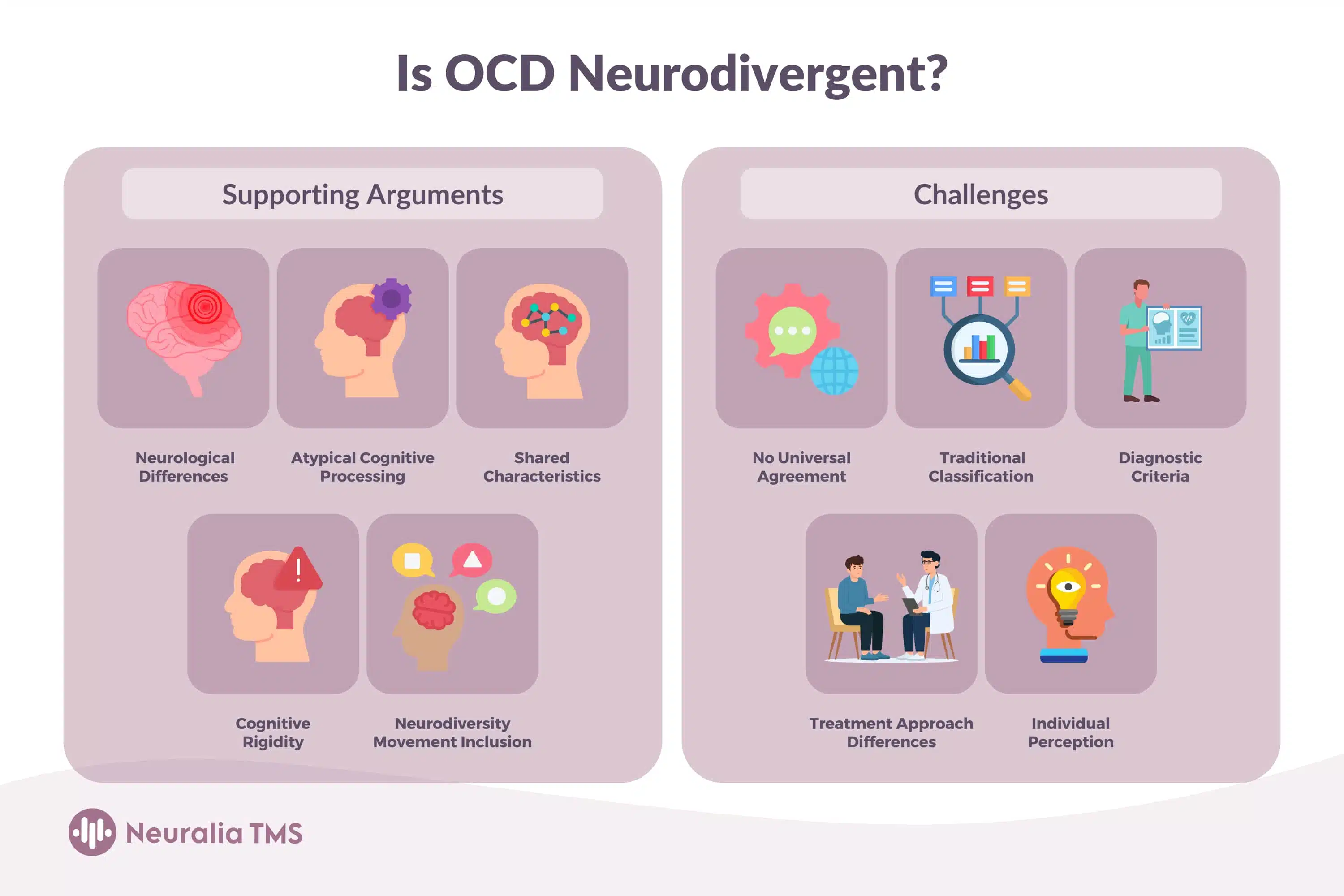
Neurological Differences
Individuals with OCD show distinct neurological patterns, particularly in brain areas related to decision-making and habit formation. These differences support the classification of OCD as a neurodivergent condition.
Atypical Cognitive Processing
People with OCD process thoughts differently from what is considered neurotypical. Their brains show higher levels of activity in regions related to planning, judgment, and body movements, which likely leads to increased obsessions and compulsions.
Shared Characteristics
OCD shares many symptoms with other neurodivergent conditions, especially ritualistic behaviours, persistent thoughts, and social challenges. This overlap suggests a neurodevelopmental foundation.
Cognitive Rigidity
Both OCD and several neurodivergent conditions feature cognitive rigidity. Cognitive rigidity manifests as difficulty adapting to new situations or changing thought patterns.
Challenges in Classifying OCD as Neurodivergent
Lack of Universal Agreement
There’s no universal agreement among clinicians on whether OCD should be categorised as a neurodivergent condition. Some experts argue that OCD is distinct from conditions like autism spectrum disorder and ADHD.
Traditional Classification
OCD has traditionally been categorised separately from neurodevelopmental conditions such as autism spectrum disorder or ADHD.
Diagnostic Criteria
The varied diagnostic criteria for OCD add to the ongoing discussion about its classification as neurodivergent. Some healthcare professionals view OCD primarily as an anxiety disorder rather than a form of neurodivergence.
Treatment Approach Differences
The treatment approaches for OCD, particularly the use of Exposure and Response Prevention (ERP) therapy, may differ from those typically used for other neurodivergent conditions.
Individual Perception
Whether someone with OCD identifies as neurodivergent can be a personal choice. It’s typically influenced by how OCD impacts their daily life, relationships, and sense of self.
Obsessive-Compulsive Disorder often has debate around whether it is a type of neurodivergence or an anxiety disorder. However, all mental health conditions, including OCD, can have a significant impact on your quality of life. If you are looking for treatment for OCD, consider Neuralia TMS’ treatment plans for OCD.
Neuralia TMS | Helping People with Their OCD Symptoms
Neuralia TMS provides you with friendly and non-invasive transcranial magnetic stimulation to help relieve the symptoms of OCD. TMS treatments use magnetic fields to stimulate nerve cells in your brain to lessen the effects of OCD symptoms on your life. We typically see people who have not had success with standard OCD treatments and are looking for a plan that is more personal and accommodating.
Speak to our friendly team about how Neuralia TMS can help you live your best life. Contact us today!
Is OCD Neurodivergent FAQs
What disorders are neurodivergent?
Neurodivergent disorders include autism spectrum disorder (ASD), attention deficit hyperactivity disorder (ADHD), dyslexia, dyspraxia, dyscalculia, and Tourette’s syndrome. Other conditions that may be considered neurodivergent are obsessive-compulsive disorder (OCD), epilepsy, Down syndrome, and certain chronic mental health conditions like bipolar disorder.
What are the three Cs of OCD?
The three Cs of OCD are Catch, Challenge, and Change, which are practical steps used in cognitive restructuring to help individuals recognise and modify distorted thinking patterns. These steps guide people with OCD to identify their obsessive thoughts, question their validity, and develop healthier thought processes to manage their symptoms.
Contact
Contact Neuralia TMS today and take a step toward a quieter, more fulfilling future.
Phone: 08 6230 3996 / 08 6230 2231
Email: info@neuralia.com.au / referrals@neuralia.com.au
Healthlink ID: neuralia
Back to top: Is OCD Neurodivergent?

Dr Shanek Wick – Author Bio
Dr. Shanek Wick, a distinguished Fellow of the Royal Australian and New Zealand College of Psychiatrists, specialises in holistic mental health care with a focus on interventional psychiatry, neurostimulation, and addiction.
Why Neuralia TMS

Lead by Psychiatrists

Next Day Consults Available

Evidence-based, individualised treatment programs

Medicare rebates available
TMS Machine Resources

PTSD Treatment in Perth: Your Options Explained
https://www.neuraliatms.com.au/wp-content/uploads/Psychological-Therapy-for-PTSD-Treatment-Perth.png
1500
1000
Neuralia TMS
//www.neuraliatms.com.au/wp-content/uploads/2023/02/neuralia-tms-colour-wide.svg
PTSD Treatment in Perth: Your Options Explained

MDMA-Assisted Therapy for PTSD: What the Evidence Shows
https://www.neuraliatms.com.au/wp-content/uploads/MDMA-Assisted-Therapy-for-PTSD-What-the-Evidence-Shows.png
1500
1000
Neuralia TMS
//www.neuraliatms.com.au/wp-content/uploads/2023/02/neuralia-tms-colour-wide.svg
MDMA-Assisted Therapy for PTSD: What the Evidence Shows

TMS vs. Antidepressants: Which Treatment Is Right for You?
https://www.neuraliatms.com.au/wp-content/uploads/TMS-vs-Antidepressants-Which-Treatment-Is-Right-for-You.png
1500
1000
Neuralia TMS
//www.neuraliatms.com.au/wp-content/uploads/2023/02/neuralia-tms-colour-wide.svg
Reviews
Punya Singh
“TMS for Tinnitus”
I had a remarkable experience at Neuralia TMS under the care of Dr. Wick and their dedicated team of staff. The staff here truly go above and beyond to make you feel comfortable and at ease throughout your journey.
vinura g
“TMS for Tinnitus”
I recently had the opportunity to visit Neuralia TMS, and I must say that my experience was nothing short of exceptional. From the moment I walked through the doors, I could sense a warm and welcoming atmosphere, which immediately put me at ease
Sonya S
“TMS for Tinnitus”
I must say Dr Shanek is one of the kindest, most humble psychiatrist I have ever met. I am so grateful to have received TMS treatment and I am impressed by the changes I have had in my mood status. Highly recommend Dr Shanek to anyone looking for an excellent Psychiatrist.
James Mons
“TMS for Tinnitus”
Dr. Shanek Wick has been absolutely fantastic to work with and came highly recommended to me via my GP. I’ve been referring people to Neuralia TMS ever since. I definitely had some hesitations prior to commencing this journey, but I felt very reassured, and most importantly, I felt heard.